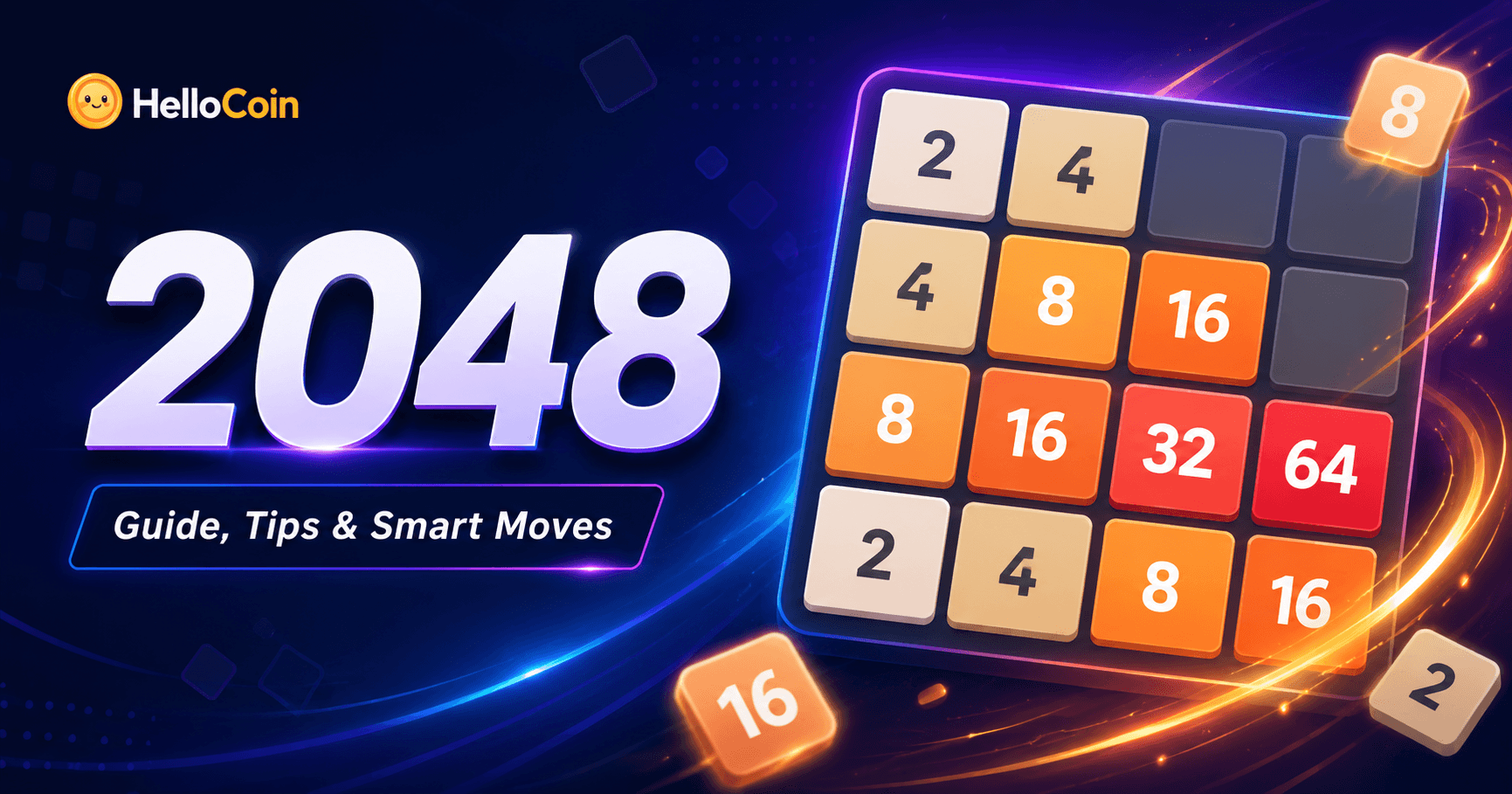
How to Play 2048: Corner Strategy, Move Order and Recovery Tips
This guide is written for the browser version of 2048 available on HelloCoin. It explains the visible rules, useful decision-making patterns, and practical mistakes to avoid without promising scores, rewards, or results.
Play: 2048 on HelloCoin
Quick game overview
| Genre | Number-merging puzzle |
|---|---|
| Main objective | Combine equal tiles and keep the board playable |
| Core skill | Planning several swipes ahead |
| Best first habit | Build toward one protected corner |
Why 2048 is more about space than arithmetic
The numbers are easy to understand: equal values merge and double. The difficult part is preserving a shape that can continue to move. Every swipe affects the whole board, and every new tile reduces the room available for future combinations. A strong position therefore has two qualities at once: the largest tiles are grouped in a predictable area, and enough low-value tiles remain free to merge.
Think of the grid as a storage problem. Large tiles need a permanent home, medium tiles need a route toward that home, and fresh tiles need temporary space. When those three jobs compete for the same square, the board becomes unstable.
Build a corner chain instead of chasing every merge
Choose one corner for the highest tile and avoid swiping in the direction that pulls it out unless the board is already lost. Around that corner, arrange descending values so that new merges can travel toward the large tile. For example, a row such as 512, 256, 128, 64 is easier to develop than the same values scattered across four different rows.
The corner rule is not magic. It works because it limits random movement. When your largest tile stays fixed, the rest of the board can be judged relative to a stable point. A move that breaks the ordered edge should solve a bigger problem than the one it creates.
A useful move-check before every swipe
- Will this move create a merge? Empty motion without a merge still adds a new tile.
- Will the largest tile remain protected? If not, can it be returned immediately?
- How many empty cells will remain? One empty cell is fragile; several empty cells give options.
- What will the board look like after the new tile appears? Leave more than one safe follow-up direction whenever possible.
How to recover when the board becomes messy
Recovery begins by stopping the damage. Do not force a large merge if it spreads medium tiles across the grid. Instead, create one or two small merges that reopen space. Rebuild the outer row first, then reconnect the inner values to it. When only one move remains available, the earlier mistake usually happened several turns before; use the next run to notice that warning sooner.
A practical warning sign is alternating values such as 8, 16, 8, 16 with no matching neighbours. They look organised but cannot merge. Try to keep duplicate values close enough to meet without moving the corner tile.
Common 2048 mistakes
- Swiping in all four directions without a fixed plan.
- Moving the highest tile away from its corner for a small immediate gain.
- Keeping no empty cells and depending on a lucky new tile.
- Merging two large tiles before the next supporting value is ready.
- Restarting too quickly instead of studying why the board locked.
More HelloCoin games to try
If you enjoy 2048 but want a different type of challenge, the following HelloCoin games provide a useful change of pace.
- Onet — Puzzle game on HelloCoin.
- Candy Match3 — Match-3 game on HelloCoin.
- Tower Builder — Casual game on HelloCoin.
Frequently asked questions
Can every 2048 game reach the 2048 tile?
No result is guaranteed because new tiles and earlier choices shape the board. Good structure improves your chances but does not remove uncertainty.
Should I always use only two directions?
Use two main directions to protect your edge, but a third direction may be needed for recovery. The fourth direction is usually the riskiest because it pulls the corner chain apart.
What matters more: score or empty spaces?
Empty spaces usually matter first. A high score cannot continue if the board has no legal merge or movement.