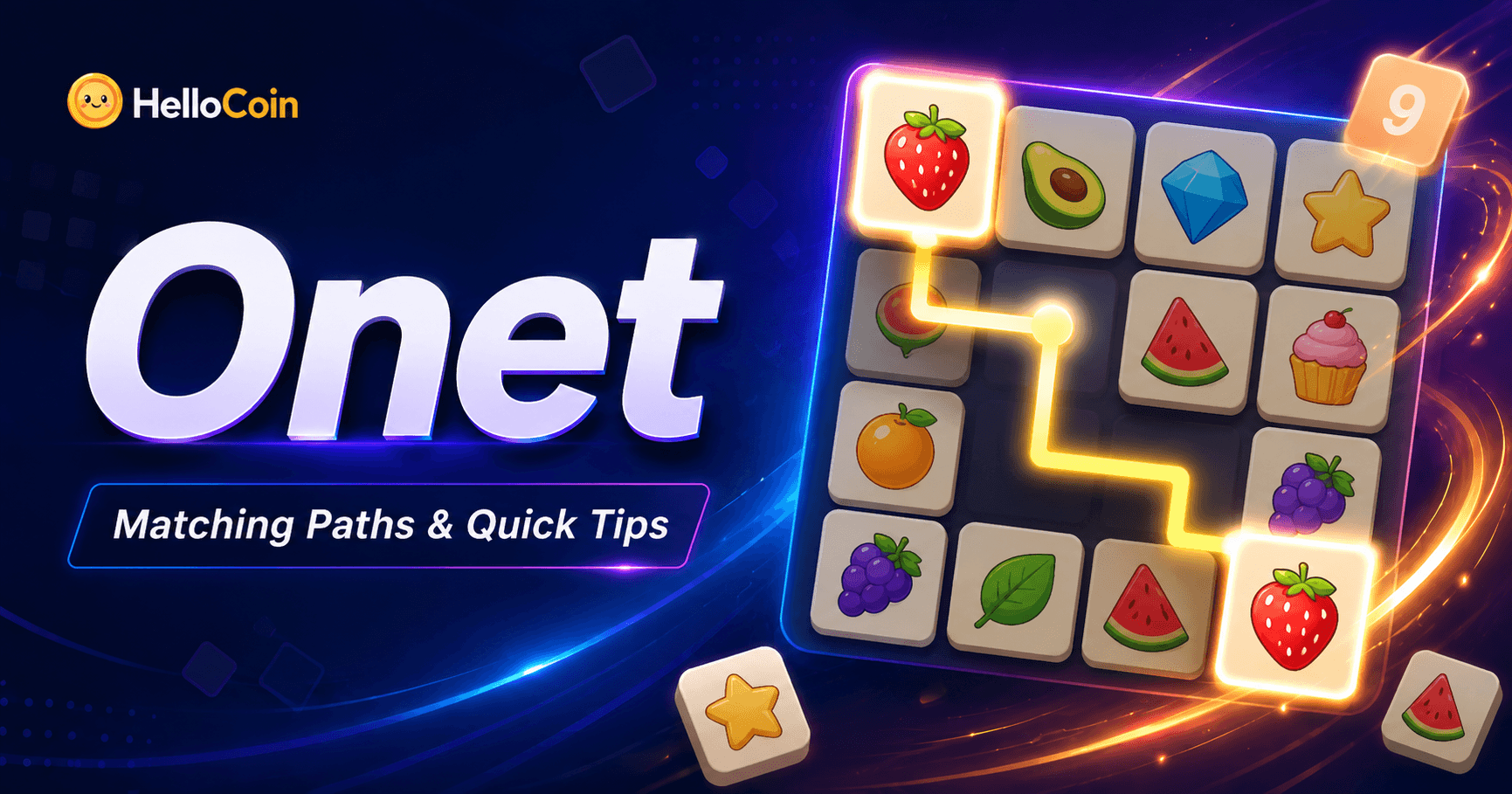
Onet Guide: Find Legal Tile Paths and Clear the Board Efficiently
This guide is written for the browser version of Onet available on HelloCoin. It explains the visible rules, useful decision-making patterns, and practical mistakes to avoid without promising scores, rewards, or results.
Play: Onet on HelloCoin
Quick game overview
| Genre | Tile-connection puzzle |
|---|---|
| Main objective | Remove matching tiles through a legal path |
| Path rule | The connection must avoid other tiles and use no more than two turns |
| Best habit | Clear accessible edges to create new routes |
Matching symbols are only half of the puzzle
Two identical tiles cannot always connect. The route between them must remain clear and stay within the allowed number of turns. This means every selection has two checks: visual identity and path geometry. A pair can look perfect but remain blocked by one tile in the middle.
Train yourself to trace the route before selecting. Look for straight lines first, then one-turn L shapes, then routes that travel around an open edge with two turns.
Why perimeter pairs are valuable
Tiles near the outside often connect through the empty space beyond the grid. Removing them also expands access to the next layer. Early perimeter clears therefore provide both immediate progress and future routes. However, do not remove every easy edge pair without looking ahead; some pairs may be useful after the board shifts.
Re-scan after every removal
The legal map changes whenever tiles disappear. A previously blocked pair may gain a straight corridor, while a shifting layout may move symbols into new positions. Instead of continuing with the pair you noticed earlier, scan the updated board from the edges toward the centre.
A consistent scan pattern—top row, right edge, bottom row, left edge, then centre—reduces repeated searching.
Plan for board movement
If the level shifts remaining tiles after a match, the current route is not the only consideration. Ask where the surrounding symbols will move. A clear that joins another pair is valuable; a clear that separates duplicates may make the next stage slower. When several legal matches exist, prefer the one that opens more empty lines.
Common Onet errors
- Selecting a pair without checking the full route.
- Searching randomly instead of using a fixed scan order.
- Ignoring paths that travel around the outside edge.
- Continuing to look at the old board after tiles shift.
- Using shuffle or hints before checking newly opened corridors.
A practical scanning drill
Choose one symbol family and scan the board in the same route each time: top edge, right edge, bottom edge, left edge, then centre. For every duplicate, trace straight, one-turn, and two-turn paths in that order. After a successful match, restart the scan rather than resuming from the old location. This drill trains consistency and reduces the tendency to stare repeatedly at one blocked pair.
More HelloCoin games to try
If you enjoy Onet but want a different type of challenge, the following HelloCoin games provide a useful change of pace.
- Candy Match3 — Match-3 game on HelloCoin.
- Memory Village — Memory game on HelloCoin.
- 2048 — Puzzle game on HelloCoin.
Frequently asked questions
Can a path go outside the tile grid?
Many Onet versions allow a route through the empty outer border. Follow the live board’s visual feedback to confirm.
Why does a matching pair fail to connect?
Another tile may block the corridor, or the route may require more turns than the rule permits.
What should I clear first?
Accessible edge and adjacent pairs are often useful because they create space, but compare all available moves when the board shifts.